NFL Wordle — Guess the NFL Player
NFL Wordle gives you one mystery NFL player a day. Eight guesses. Six clues each time.
How NFL Wordle works
NFL Wordle is a daily player guessing game built on a fixed pool of 396 active NFL players. One of them is chosen for today, and you have eight guesses to name him. You do not type free text into a blank box: the input suggests players from the pool as you type, and only a name on that list can be submitted. That keeps every guess gradeable and stops spelling variants from wasting one of your eight turns.
After each guess the board fills one row of six cells. The cells are always in the same order: team, position, age, height, weight and jersey number. Two of them are categories and four of them are numbers, which is why four of the cells can also show a direction arrow. Green means an exact match. Yellow means close. Grey means you are further away. A win needs all six cells green in the same row — a near miss in any single dimension is still a miss.
The pool behind this page is the 2026 active roster, filtered to players a fan could plausibly name. In practice that means a first-, second- or third-round draft pick with at least three seasons in the league, whose team, position, age, height, weight and jersey number are all present in the source data. That leaves 396 players across 31 teams and eight divisions. Specialists are excluded as a group: kickers, punters and long snappers are so scarce after the same filter that a green position cell would nearly identify the answer on its own.
The six clue cells, one by one
Each cell has its own rule. The two category cells compare group membership, and the four numeric cells compare a difference against a fixed threshold. These thresholds are the same for every guess and every day; they are not tuned to the day's answer.
- Team shows the abbreviation of the player you guessed. Green means the same team, yellow means a different team in the same division, and grey means a different division. The eight divisions are the four AFC and four NFC divisions, so a yellow team cell narrows the answer to at most three other clubs.
- Position shows the position group, not the fine-grained position. There are eight groups in the pool: defensive backs, offensive linemen, defensive linemen, linebackers, wide receivers, quarterbacks, tight ends and running backs. Green means the same fine position, yellow means a different fine position inside the same group, and grey means a different group. This is why a cornerback and a safety both display DB: they are different fine positions in one group, so one turns the other yellow rather than grey.
- Age is a whole number of years, calculated from date of birth against a fixed reference date so the number does not drift through the season. Green is exact, yellow is within two years, grey is further. An up arrow means the answer is older.
- Height is displayed in feet and inches but compared in inches. Green is exact, yellow is within two inches, grey is further. An up arrow means the answer is taller.
- Weight is in pounds. Green is exact, yellow is within ten pounds, grey is further. An up arrow means the answer is heavier.
- Jersey number runs from 0 to 99 in this pool. Green is exact, yellow is within three numbers, grey is further. An up arrow means the answer wears a higher number.
The arrows matter more than the colours once you are down to a handful of candidates. A grey cell with an up arrow is not a dead end: it tells you which half of the pool to eliminate. Team, position, age, height, weight and jersey number each cut the remaining candidates in a different direction, so two or three guesses are usually enough to isolate a small set of names. The eight guess limit is generous by design, but the game is won by reading the arrows, not by cycling through names.
A worked example from the pool
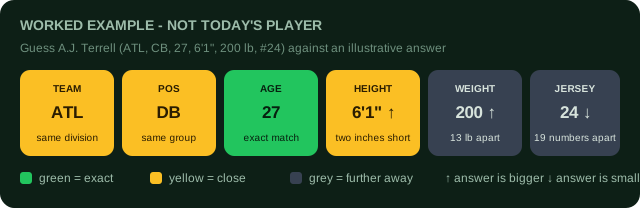
Here is a complete row built from two real players in the pool. This is an illustration of how the grading works, not today's answer.
Suppose you guess A.J. Terrell: Atlanta, cornerback, 27 years old, 6 ft 1 in, 200 lb, number 24. Imagine the answer is Ifeatu Melifonwu: Tampa Bay, safety, 27, 6 ft 3 in, 213 lb, number 5. Both are in the NFC South and both are defensive backs, so the team cell and the position cell come back yellow rather than grey. Age is an exact 27, so that cell is green. The answer is two inches taller, which is exactly the height threshold, so height is yellow with an up arrow. The 13-pound gap is beyond the ten-pound threshold, so weight is grey with an up arrow. The 19-number gap is beyond the three-number threshold, so jersey is grey with a down arrow.
That single row tells you a lot: the answer is a defensive back in the NFC South, exactly 27, slightly taller than 6 ft 1 in, heavier than 210 lb, and wearing a low number. Guessing another NFC South defensive back then narrows the team by colour alone, and the four arrows tell you whether to move up or down on each measurement. This is the whole loop of the game — pick a name, read six cells, pick a name that satisfies all six constraints.
One player, one day
The answer is tied to the calendar, not to your account. The schedule starts on 4 November 2026 and contains one entry for each of the 396 players, in a fixed order that does not repeat until the whole pool has been used. The day number is calculated from your device's local date, so everyone on the same calendar day gets the same player and the same clues, and a new one appears at local midnight. There is no account, no email address and no payment.
Your guesses, your result and your streak are stored in your own browser under two keys that belong to this game alone. The play-calling game keeps its progress under a different key, so the two games never share a streak — a good day in one does not rescue a missed day in the other. Clearing your browser data resets both. The streak increases when you win on consecutive days and restarts at one after a win that follows a miss or a skipped day.
The share text is built from coloured squares and your score, such as 4/8 or X/8. It contains no player name, no team and no clue values, so posting it cannot spoil the answer for somebody who has not played yet. You can copy it to the clipboard or use your device's share sheet, and it always carries a link back to this page.
Where the player details come from
Rosters, fine positions, heights, weights and jersey numbers come from nflverse open data, published under CC BY-SA 4.0. Two files are used: a player file with biographical and draft details, and the 2026 roster file with the current team and jersey number. Because teams have bye weeks on different dates, each player is read from the most recent week in which he actually appears, rather than from one league- wide snapshot. Ages are derived from date of birth. Nothing on the board is hand-entered or estimated.
The fine position comes from the player file rather than the roster file, and positions are mapped into the eight groups shown on the board: cornerbacks and safeties become DB, tackles and guards become OL, ends and tackles on the defensive line become DL, and so on. Without that mapping a yellow position cell would almost never appear, because two players rarely share an identical fine position label. The grading rules live in a small standalone function with a fixed set of thresholds, and they are covered by unit tests so that a change to the display cannot silently change what counts as a win.
The pool is not uniform, and that is part of the puzzle. Defensive backs are the largest group at 74 players, followed by offensive linemen at 71, defensive linemen at 65, linebackers at 62, wide receivers at 48, quarterbacks at 31, tight ends at 27 and running backs at 18. Ages run from 23 to 42 with an average of 28.2; heights from 67 to 80 inches with an average of 74.6; weights from 165 to 360 pounds with an average of 249.5; jersey numbers from 0 to 99 with an average of 43.6. The AFC North contributes 65 players, the most of any division, and the NFC West 36, the fewest. Knowing that distribution is useful: a green quarterback cell is far more decisive than a green defensive-back cell, simply because there are 31 of the former and 74 of the latter.
Common questions
How many guesses do I get in NFL Wordle?
Eight. Each guess returns six clues: team, position, age, height, weight and jersey number. Green means an exact match, yellow means close, grey means further away. All six must be green in the same row to win.
Is NFL Wordle the same player for everyone?
Yes. The player is fixed to the calendar date, so everyone playing on the same day gets the same answer and the same clues. A new player appears each day, and the 396-player order does not repeat until it has run through the whole pool.
Do I need an account?
No. There is no signup, no email and no payment. Today's guesses and your streak are stored in your own browser under two separate keys, and clearing browser data resets both.
Where do the player details come from?
Rosters, positions and measurements come from nflverse open data, published under CC BY-SA 4.0. Ages are calculated from date of birth against a fixed reference date. Nothing is hand-entered or estimated.
What does a yellow square mean?
Yellow means close but not exact. For team it means the same division; for position it means the same position group. For the four numeric clues it means the answer is within two years of age, two inches of height, ten pounds of weight, or three jersey numbers of your guess.
Why are there no kickers or punters?
Specialists are excluded from the pool. The selection rules leave too few of them to be viable answers, so a single green position clue would give the player away. The pool uses 396 active players across 31 teams and eight position groups instead.
Can I play an older NFL Wordle puzzle?
No. Only today's player is available here, and the game does not keep a playable archive. The play-calling game on this site does keep a seven-day archive of past drills.
Want a different game?
The play-calling game uses the same NFL play-by-play data for a different question: given a real late-game situation, what would you call? If you want the background on those situations first, read what a two-minute drill is, see what 1,095 situations say about play calling, or check when going for it on fourth down wins. The full rules and scoring for the play-calling game are on a separate page.