When should teams go for it on fourth down?
When should teams go for it on fourth down? Almost every argument about it starts with the distance: fourth and inches, fourth and one, fourth and long. When we graded 360 fourth-down decisions from real late-game situations by win probability, the distance turned out not to be the first thing that matters. The scoreboard was.
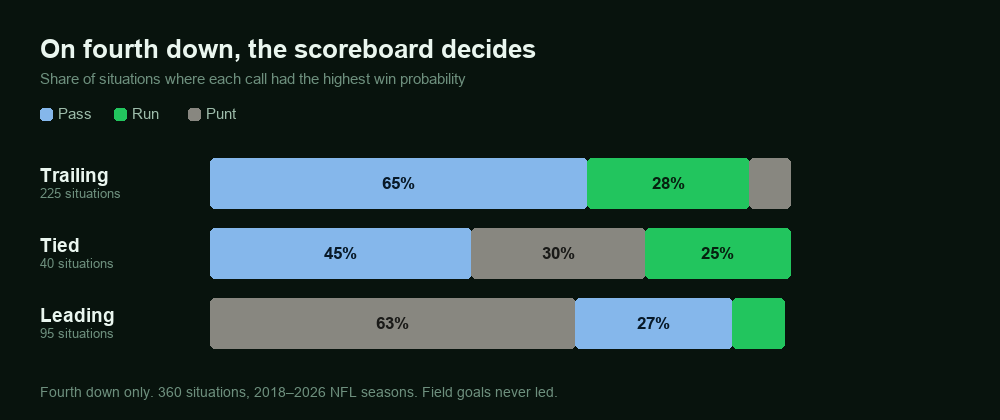
The scoreboard comes first
Split the 360 fourth downs by the state of the game and the decisions stop looking like one decision at all.
| Game state | Situations | Best call | Runner-up |
|---|---|---|---|
| Trailing | 225 | Pass 65% | Run 28% |
| Tied | 40 | Pass 45% | Punt 30% |
| Leading | 95 | Punt 63% | Pass 27% |
When a team is behind, punting is the best call only 7% of the time. When a team is ahead, punting is the best call 63% of the time. That is the same down, often the same field position, and almost the opposite recommendation.
The logic is not mysterious once you say it out loud. A team that trails needs possessions, and giving the ball away voluntarily costs it one. A team that leads needs to end the game, and a punt that burns forty seconds and pins the opponent deep does more for that goal than a conversion attempt that fails at midfield.
Then the distance, and where you are on the field
Field position changes the answer too, and in a way that is easy to miss. The question is not only how far you need, but how far the opponent needs if you fail.
| Ball on | Situations | Best call |
|---|---|---|
| Opponent 1–5 | 22 | Run 73% |
| Opponent 6–15 | 32 | Pass 72% |
| Opponent 16–30 | 77 | Pass 71% |
| Opponent 31–50 | 115 | Pass 54% |
| Own half | 114 | Punt 44% |
Inside the five, running is the answer three times out of four: the end zone is closer than the first down marker, so the usual calculus inverts. From the opponent's six to the thirty, passing dominates, because a failed conversion leaves the opponent with a long field either way and the clock rewards gaining as much as possible per play. Only once you are past midfield does punting become the plurality choice, and even there it is 44%, not a default.
The distance within the down still matters, and we broke that out separately in the play-calling breakdown: on fourth and three to five, running was never the best call in 68 situations.
When punting is actually right
Punting was the best call in 88 of the 360 situations, and those 88 share a narrow profile. Every one of them came with the ball on the opponent's 31 or further out — 38 from the 31 to the 50, and 50 from the team's own half. The average spot was the 53, with 12.4 yards to go and 85 seconds left.
Read that combination carefully: long distance, deep in your own territory, limited time. Punting is right when a failed conversion hands the opponent a short field with the clock already against you, and when the distance is long enough that conversion is unlikely in the first place. Take away any one of those three conditions and the answer usually flips.
The field goal problem
Here is the number that surprised us most. Coaches kicked a field goal on fourth down 95 times in this sample. Those kicks gave up an average of 9.4 percentage points of win probability compared with the best available call, and not one of them was the optimal decision.
The average field goal attempt came from the opponent's 25 with 126 seconds left — a kick of roughly 42 yards, worth three points, in a game where a touchdown was still reachable and the clock still allowed it. Trading a possession for three points in that spot is expensive, and it is expensive in a way that does not show up on the scoreboard until later.
This is not an argument that kicking is always wrong. It is an argument that in the specific band of the game we study — late, close, clock-limited — the field goal is almost always the worst of the available options, and it is chosen far more often than that.
Why the gap persists
The obvious explanation is that coaches are bad at math. That is probably part of it, but it is not a satisfying answer, because the analytics have been public for years.
A better explanation is that the incentives are asymmetric. A coach who goes for it and fails is asked about it in the postgame press conference and again all week. A coach who punts and loses is asked about the defense. Two decisions with identical expected value do not carry identical personal risk, and people respond to the risk they can see.
There is also a real information gap. The model knows the down, distance, clock and score. It does not know that the right guard is hurt, that the opponent has been stopping the same run all half, or that the kicker has been shaky in warmups. A coach has that information and it should move the decision. What it rarely does is move it by nine percentage points.
What this does not say
It does not say a specific coach made a specific mistake. It says that across a large sample, the decisions made in these spots systematically gave up more win probability than the alternatives available — and that the pattern is consistent enough to be structural rather than random.
It also does not say the model is right about any single case. What it says is that if you faced these 360 decisions and always took the highest-win-probability option, you would have won more often than the teams that actually played them. That is a statement about process, not about any one outcome.
If you want to test your own instincts against these situations, that is exactly what the daily drill does: one real spot, one call, graded on what the decision was worth rather than what happened next. For the background on how these spots arise, what a two-minute drill is covers the three versions and why the clock changes every answer.
Data note: play-by-play from nflverse under CC BY-SA 4.0, modified and re-aggregated. 360 fourth-down situations from the 2018–2026 seasons, all in late-game or end-of-half states. Win probability is estimated from historical outcomes in comparable game states. Percentages are rounded.